
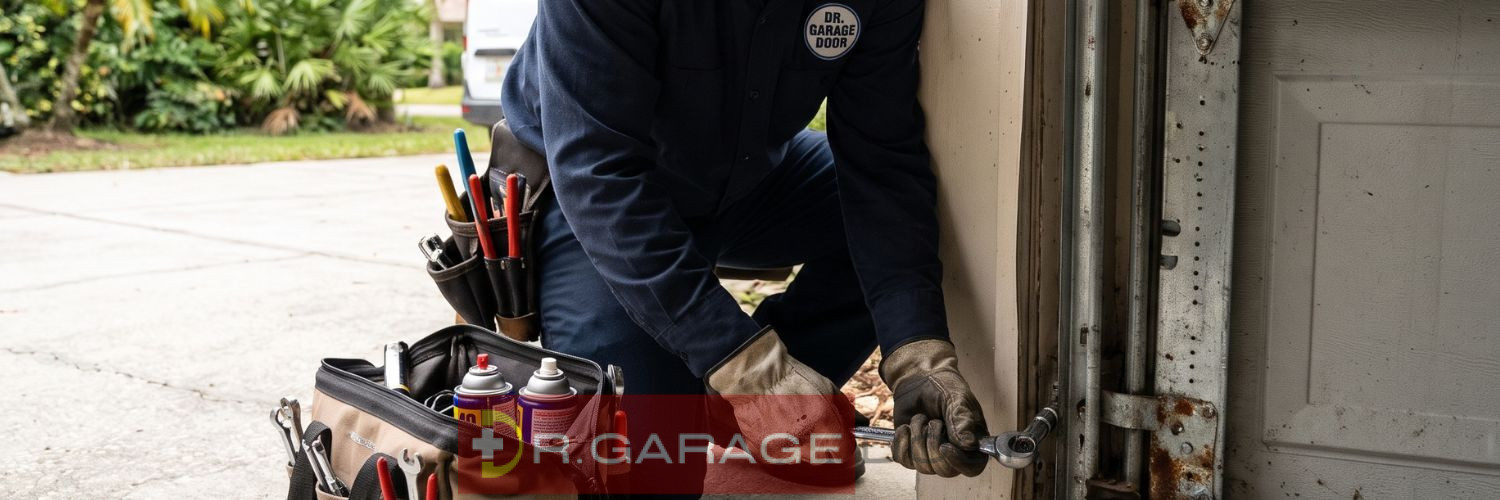
Returning Snowbirds Why Your Vacant Florida Garage Door is Jammed This November
It is November 2026, and the great migration has officially begun. Thousands of winter residents and snowbirds are making their way back down to Central Florida to escape the freezing northern temperatures. You pull into your driveway after a long multi-day drive, press the button on your visor remote, and anticipate the welcoming sound of your garage door opening. Instead, you hear a strained mechanical groan, a loud metallic snap, or perhaps absolutely nothing at all. The door is completely stuck, and your vehicle is left sitting in the driveway. This is an incredibly common and frustrating scenario for returning winter residents. Leaving a home vacant through the brutal Florida summer takes a massive toll on mechanical systems. When this happens, professional garage door repair Central Florida is the fastest and safest way to revive your dormant system and secure your home for the winter season.
While you were away enjoying a mild northern summer, your Florida garage was subjected to months of extreme heat, oppressive humidity, and severe tropical weather. Garage doors are heavy, complex mechanical systems that are designed to move. When they sit entirely idle for six to eight months in a harsh subtropical climate, the lack of kinetic movement allows corrosion, thermal expansion, and lubrication breakdown to completely lock up the system. Understanding the physics behind why your door is jammed is the first step toward getting it safely operational again.
The Hidden Toll of the Florida Summer on Vacant Properties
To understand why your garage door fails upon your return, we have to look at the environment inside your garage from May through October. An unconditioned garage in Central Florida operates much like a greenhouse. While the outside temperature might read 95 degrees, the trapped radiant heat inside the garage can easily push ambient temperatures well above 130 degrees. Combined with regular humidity levels hovering between eighty and ninety percent, you have the perfect recipe for accelerated metal corrosion and the rapid degradation of synthetic materials.
Mechanical systems thrive on regular use. Every time a garage door opens and closes, it distributes lubrication along the tracks, exercises the torsion springs, and clears minor surface dust from the photo-eye sensors. When the door sits perfectly still for half a year, all of those moving parts essentially fuse together. The grease dries out, the rubber melts, and the raw steel begins to rust. Attempting to force the door open with the electric opener motor after it has seized can cause catastrophic damage to the tracks, the cables, and the motor itself. This is exactly why expert diagnostics and targeted repair services are so critical upon your return to the state.
How High Humidity Destroys Unused Moving Metal Parts
The most immediate victim of a vacant Florida summer is the hardware holding your garage door together. The rollers, hinges, and tracks are highly susceptible to moisture-induced degradation when left undisturbed. Condensation forms on cold metal surfaces overnight and bakes into the steel during the heat of the day. This endless daily cycle of sweating steel rapidly breaks down factory lubricants.
If your garage door is equipped with standard, unsealed steel roller bearings, the humidity penetrates the bearing races. Without the daily rolling action to keep the ball bearings freely moving, iron oxide forms quickly. By the time November rolls around, those tiny steel bearings have essentially rust-welded themselves together into a solid chunk of metal. When you press your remote, the frozen rollers cannot spin. Instead, they drag forcefully against the vertical tracks. This metal-on-metal dragging causes immense friction, overwhelming the safety sensors on your opener and forcing the door to reverse or jam halfway up the wall.
Furthermore, the hinges that connect your heavy door panels can stiffen and seize. When the hinges lose their flexibility, the door cannot properly navigate the curved portion of the steel track. A stiff hinge will fight the lifting motion, causing the entire door to shake, rattle, and eventually bind tight in the tracks. Upgrading your hardware with heavy-duty sealed nylon rollers and freshly lubricated hinges through a dedicated repair service will eliminate this friction and restore smooth operation.
The Melted Weather Seal Dilemma Fusing to the Concrete
Another major reason your garage door refuses to budge in November involves the rubber astragal mounted to the bottom panel. This heavy-duty weather seal is designed to compress against your concrete floor to keep out water, pests, and drafts. However, rubber and intense, prolonged heat do not mix well.
During the peak of August, the concrete threshold of your garage can become incredibly hot from direct afternoon sunlight. The bottom rubber seal softens and partially melts under the extreme temperature and the heavy compressive weight of the door itself. Over several months of sitting idle, the melted rubber chemically bonds with the porous concrete floor. It acts almost like a high-strength adhesive.
When you finally return and activate the opener motor, the machine attempts to pull the door upward. Because the bottom seal is glued to the floor, the motor strains against a massive amount of unnecessary resistance. In many cases, the motor will simply hum and shut off to prevent an electrical fire. In worse scenarios, the motor pulls hard enough to rip the rubber seal completely off the bottom of the door, or it strips its own internal plastic drive gears trying to break the seal. A professional technician can safely pry the door loose, clean the concrete threshold, and install a fresh, temperature-resistant EPDM rubber seal to protect your home from winter drafts and pests.
Torsion Spring Degradation The Hidden Danger Above Your Door
The absolute most dangerous component of a dormant garage door system is the high-tension torsion spring assembly mounted directly above the header. These heavy steel coils are responsible for counterbalancing the massive weight of the door. A two-hundred-pound door only feels like it weighs ten pounds because the wound springs are constantly pulling against gravity.
When a garage door is closed, the torsion springs are stretched to their maximum tension. Leaving the springs fully wound and under maximum stress for six straight months in a sweltering environment causes the steel to suffer from extreme thermal fatigue. The heat causes the metal to expand, while the high humidity introduces surface rust between the tightly wound coils. This rust creates high-friction binding points.
When you finally open the door in November, the sudden movement forces the rusted, brittle coils to violently snap apart. A breaking torsion spring sounds like a shotgun blast inside your garage and instantly renders the door completely immovable. Torsion spring repair requires highly specialized tools and deep technical knowledge. Because these springs hold lethal amounts of stored kinetic energy, homeowners should never attempt to adjust or replace them independently. Our seasoned technicians utilize calibrated winding bars to safely remove compromised summer-stressed springs and replace them with high-cycle, powder-coated alternatives that resist Florida humidity.
Electronic Failures Summer Lightning and Fried Logic Boards
Sometimes the mechanical hardware is perfectly fine, but the door still refuses to open. Central Florida is famously known as the lightning capital of the United States. Throughout July, August, and September, severe afternoon thunderstorms generate massive electrical surges that travel through neighborhood power grids. If your home was struck by lightning or experienced a significant power surge while you were up north, your garage door opener was likely the first appliance to absorb the hit.
The logic board inside your opener motor is a highly sensitive microcomputer. A power surge can easily fry the internal circuitry, erasing the remote control memory or completely destroying the board’s ability to send power to the motor. If your wall button is completely dark, or if your remotes fail to trigger any response from the overhead unit, electrical damage is the most likely culprit.
Additionally, if your opener features a battery backup system, the battery has likely drained completely dry over the summer. Extreme heat destroys battery cells rapidly, leaving the unit incapable of operating during a standard winter power outage. Professional electronic diagnostics can pinpoint exactly where the voltage is dropping, allowing for precise logic board replacements or circuit repairs without having to throw away the entire motor unit.
Why Traditional DIY Quick Fixes Do More Harm Than Good
When faced with a jammed garage door, the immediate instinct for many returning homeowners is to grab a can of standard WD-40 and spray everything in sight. Unfortunately, this is one of the worst things you can do for a seized overhead system. Traditional WD-40 is a solvent and a degreaser, not a heavy-duty mechanical lubricant. Spraying it into your seized roller bearings or dry torsion springs will actually strip away whatever residual factory grease is left, leaving the metal completely bare and highly susceptible to even faster rusting.
Furthermore, attempting to force a crooked or jammed door down the tracks by hanging on it or pulling heavily on the lift cables can result in severe physical injury. The lift cables are under extreme tension from the springs. If a rusty cable snaps while you are pulling on the door, it can cause deep lacerations. The safest and most economical approach is to leave the door exactly as it is and call for an emergency diagnostic inspection. Let the professionals handle the heavy lifting, the dangerous tension, and the proper application of climate-specific lithium-based lubricants.
The Essential Snowbird Garage Door Revival Checklist
Before you start unpacking your vehicle and settling in for the Florida winter, you need to ensure your home is secure and accessible. A comprehensive garage door revival service touches on every single point of failure that the summer heat left behind. A thorough professional tune-up should include a multi-point inspection to guarantee safety and reliability for the rest of the season.
The process begins with a full balance test to ensure the torsion springs have not lost their lifting power. Next, every inch of the steel track is inspected for rust and debris, and the vertical alignment is checked to prevent dragging. All unsealed rollers are evaluated and, if seized, replaced with quiet nylon alternatives. The technician will then apply heavy-duty synthetic lithium grease to the hinges, bearing plates, and spring coils to restore fluid movement. Finally, the electronic safety eyes are cleaned of summer dust and precisely realigned so the door reverses properly if an obstacle is detected.
By addressing these issues proactively upon your return, you prevent a minor friction issue from escalating into a completely stripped motor gear or a collapsed door panel during the busy Thanksgiving holiday.
Trust Dr Garage Door for Your Florida Winter Return
At Dr. Garage Door, we understand the unique challenges that the Central Florida climate presents for part-time residents and snowbirds. We know how frustrating it is to arrive after a long journey only to find your property locked down by mechanical failure. We are deeply committed to providing fast, reliable, and highly specialized repair services to get your winter season started on the right foot.
Please note that Dr. Garage Door focuses exclusively on providing expert maintenance, part replacements, and comprehensive repairs. We do not perform new door installations; instead, we dedicate all of our resources, inventory, and technical expertise to fixing and servicing the equipment you already have. By specializing strictly in repair and replacement parts, we ensure that our trucks are always fully stocked with the exact springs, rollers, cables, and logic boards needed to fix your system on the very first visit.
Do not let a jammed, rusted, or stubborn garage door ruin your return to the Sunshine State. If your system is groaning, shaking, or refusing to open this November, contact Dr. Garage Door today for professional, reliable, and prompt garage door repair Central Florida.
Book your snowbird revival maintenance service today by visiting our scheduling page: https://garagedoorsofcentralflorida.com/contact-us